Tu B'Av
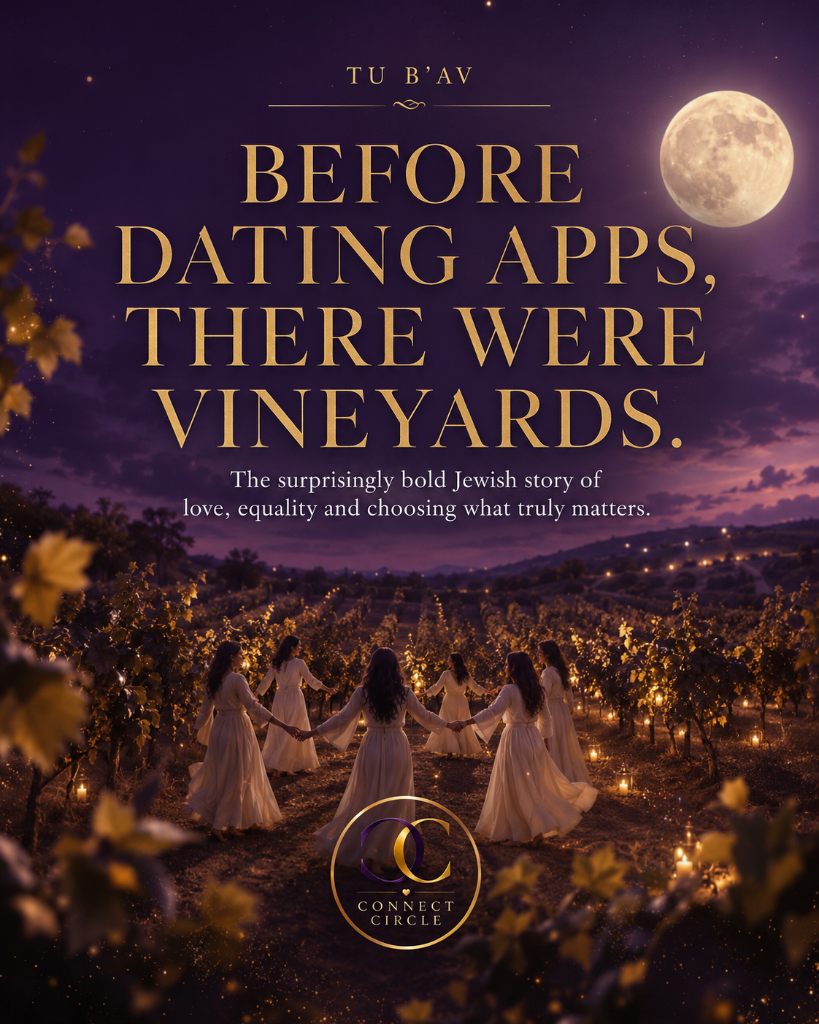
Before Dating Apps,
There Were Vineyards
The surprisingly bold Jewish story of love, equality and choosing what truly matters.
Long before dating apps, curated profiles and the exhausting question of whether someone has seen your message but chosen not to reply, Jewish women dressed in white and danced beneath the stars.
This was Tu B'Av.
It sounds almost cinematic: moonlight over the vineyards, music in the air, young women dancing while unmarried men came to meet them. For an ancient religious text, the scene feels surprisingly bold, feminine and alive.
But the most beautiful detail is not the dancing.
It is the dresses.
The Mishnah tells us that the women wore borrowed white garments. Even those who owned beautiful dresses borrowed from someone else, so that no woman would be embarrassed because of what she could not afford.
Before love entered the vineyard, status had to leave it.
There were no designer labels, no visible signs of wealth and no carefully constructed image announcing who was important. Every woman arrived in white. Every woman arrived equal.
There is something deeply moving about that — especially for women.
We know how easily the world turns us into something to be evaluated. How quickly we learn to wonder whether we are beautiful enough, young enough, interesting enough, successful enough or effortless enough. Even when nobody says it aloud, many women carry the quiet pressure to present a polished version of themselves: attractive but not trying too hard, accomplished but never intimidating, vulnerable but not complicated.
The women of Jerusalem entered the vineyard without those signals.
Not because beauty was forbidden, but because beauty was not allowed to become the whole story.
The women called upon the men to lift their eyes and consider what they were truly choosing. Look beyond the first impression. Look at character. Look at values. Look at the woman with whom you might build a life.
In other words: do not only ask whether she catches your eye. Ask whether she can hold your heart.
That might be one of the most radical messages Tu B'Av offers us. A woman is not packaging. She is not a photograph, a dress, an age or a collection of qualities designed to make her easy to choose. She is a world. A history. A soul. She carries dreams, fears, strength, tenderness and chapters that cannot be understood in a single glance.
Yet there is something even more surprising hidden in the sources.
The Mishnah places Tu B'Av beside Yom Kippur, declaring that there were no happier days for the Jewish people than these two.
At first, it seems like an impossible pairing. Tu B'Av is associated with love, dancing and connection. Yom Kippur is a day of fasting, confession and forgiveness.
What could romance possibly have to do with Yom Kippur?
Perhaps everything.
Yom Kippur asks us to remove the performance. We arrive without pretending to be perfect. We acknowledge where we have failed, ask to be forgiven and believe that we are still worthy of beginning again.
Maybe real love asks us to do the same.
Attraction may begin with seeing someone at their most beautiful. Intimacy begins when we allow ourselves to be seen without the costume.
Not only when we are glowing and confident, but when we are tired, uncertain or not at our best. Not only when the conversation flows, but when something hurts and we struggle to explain it. Not only when a relationship feels effortless, but when two people must decide whether being right matters more than remaining connected.
This is where Tu B'Av stops being an ancient matchmaking story and begins speaking directly to our lives.
Because every meaningful relationship eventually leaves the vineyard.
The music becomes quieter. The perfect dress is put away. Real life enters carrying responsibilities, disappointments, misunderstandings, children, work, pressure and all the small moments in which a woman can begin to feel invisible.
The question is no longer only, “Will someone choose me?”
It becomes, “Will they continue to see me?”
Will they see the woman beneath everything she does for everyone else? Will they notice the dreams she postponed, the worries she carries quietly and the strength that has become so reliable that people forget it also needs tenderness?
And can she still see herself?
Many women become so skilled at holding families, friendships and communities together that they slowly disappear inside the role of being needed. Tu B'Av reminds us that love is not only the joy of being chosen by someone else. It is also the courage to stop abandoning the parts of ourselves that deserve to be known.
The date itself carries another extraordinary message. Tu B'Av arrives only six days after Tisha B'Av — the day on which we mourn destruction, division and baseless hatred.
Judaism does not wait for every wound to disappear before speaking about love.
Six days after sitting on the floor and grieving what was broken, we rise and enter the vineyard.
The Talmud's explanations for Tu B'Av repeat this movement. Tribes that had been separated were once again permitted to marry one another. The tribe of Benjamin was welcomed back into the nation. Barriers preventing people from travelling to Jerusalem were removed.
Tu B'Av was not created to celebrate perfect love.
It celebrated restored connection.
That may be the most powerful lesson of all. Love is not proven by never disappointing one another. It is revealed by what we do after disappointment. It lives in the conversation we were tempted to avoid, the apology offered without excuses, the hand extended after distance and the willingness to look again at someone we thought we had already understood.
There is something undeniably romantic about new love — the anticipation, the mystery, the feeling that anything could happen.
But there is another kind of romance that is quieter and perhaps far more daring: looking at someone whose imperfections you already know and choosing to meet them again with curiosity. Allowing a relationship to become new without needing a new person. Remembering that familiarity should deepen attention, not replace it.
Tu B'Av asks us to remove the dresses we borrow from the world: the need to appear perfect, unbothered and endlessly capable.
It invites us to stand honestly before the people we love and say:
This is who I am beneath everything I perform.
Can you still see me?
Can we begin again from here?
Before dating apps, there were vineyards.
Before perfect profiles, there were borrowed white dresses.
And before Judaism celebrated love, it taught us its most intimate secret:
Love does not begin when someone finally sees a perfect version of you.
Love begins when the performance ends — and you discover that you are still worthy of being seen, chosen and cherished.
Based on Mishnah Ta'anit 4:8 and Taanit 30b–31a
A Tu B'Av Gift
For the Women of Connect Circle

In celebration of Tu B'Av, Connect Circle has partnered with Yemaya Spa & Hair to offer every woman in our circle a gift of pampering.
Enjoy 50% off — up to R250 at Yemaya Sea Point & Canal Walk.
How to redeem:
Present this page (or the voucher visual) at Yemaya Sea Point or Canal Walk.
Offer valid for members of the Connect Circle WhatsApp group / website.
Valid until 30 November 2026.
Wishing you a Tu B'Av filled with love, connection and the courage to be truly seen.
With warmth,
Mazi & the Connect Circle Team
Cape Town, South Africa · Connect Circle
Dedicated to the memory of Rebbetzin Rachel bat Matityahu, of blessed memory